


- Consumer Products
Back
Consumer Products
- Switches and Sockets
- Accessories
- Wires, Cables and Tapes
- Switchgear and Protection Devices
- PVC Conduits and Accessories
Back
PVC Conduits and Accessories

- Smart Homes and Buildings
Back
Smart Homes and Buildings
- Fans and Ventilation
- Water Heaters
- LED Lighting
- Solar
- Modular Kitchen
Back
Modular Kitchen

- Home Advancements
Back
Home Advancements

- Power Tools
Back
Power Tools
- EV Charger and Accessories
- Home Appliances
Back
Home Appliances
- Industrial Products
- Inspirations
- About Us
Back
About Us
- Our Story
Back
Our Story
- Manufacturing Excellence
Back
Manufacturing Excellence
- CSR
Back
CSR
- Careers
Back
Careers
- Our Story



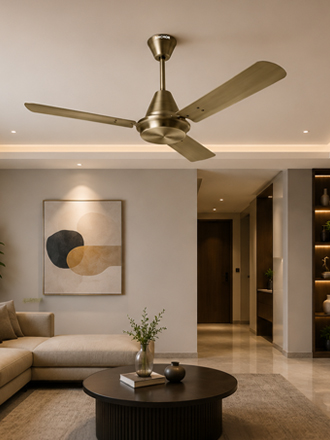


When it comes to choosing ceiling fans, one can't ignore the debate that lies between modern BLDC fans and traditional fans. As technology continues to evolve in the face of rising energy costs, most consumers are taking time to compare the benefits of BLDC fan vs normal ceiling fan to see what best suits their needs.
Having a clear idea of the fundamental differences between a BLDC fan and a normal fan helps you make more suitable choices for homes, offices, and businesses. This in-depth guide will explore all aspects of a BLDC ceiling fan compared to a normal ceiling fan, focusing on performance, cost, efficiency, and features.
Understanding Normal Fans
Most common fans are driven by AC induction motors. The induction motor uses electromagnets and carbon brushes to generate a rotating magnetic field that ultimately turns the blades. These kinds of fans have been the norm for decades due to their reliable function and low costs.
- They tend to consume more power during operation, especially at higher speeds.
- Maintenance can be needed more often, especially due to wear and tear of brush and commutator components.
- Noise output at high speeds is generally higher due to mechanical friction.
- Limitation in smart features and energy optimization, most offer only basic speed controls.
- Traditional fans are widely available and come in numerous design options, serving various interior styles.
Introduction to BLDC Fans
BLDC fans - powered by Brushless Direct Current motors - represent a recent advancement in fan technology. Unlike traditional models, BLDC fans use permanent magnets and electronic controllers to drive the fan blades.
- The core difference between BLDC fan and normal fan is that BLDC fans eliminate physical brushes, reducing friction and wear.
- BLDC fans use sophisticated electronic units to control speed, airflow, and direction, offering precise management.
- Energy conversion is more efficient as electronic commutation avoids heavy heat losses common in induction motors.
- These fans stay cool during operation and perform quietly, meeting demand in modern homes and workplaces.
- The streamlined build results in fewer mechanical failures, translating to longer lifespans and less frequent maintenance.
Key Differences Between BLDC and Normal Fans
Energy Consumption Comparison
One of the most impactful distinctions between BLDC fan vs normal fan is their energy usage.
- BLDC fans typically consume up to 65% less electricity than the equivalent normal fans, lowering monthly bills significantly.
- The absence of brushes and optimized power use puts BLDC ceiling fan vs normal ceiling fan miles ahead in terms of efficiency.
- BLDC fans consume approximately 25-35 watts of power, whereas normal fans may use 70-90 watts, showcasing significant efficiency differences over time.
- For environments where fans run continuously, such as commercial spaces, the power savings are substantial.
- Over time, a BLDC fan’s energy savings can offset initial cost differences when compared to standard fans.
Noise and Comfort Levels
Noise output can affect both comfort and sleep quality, especially in bedrooms and study areas.
- BLDC fans are almost whisper-quiet because electronic commutation eliminates friction noise from brushes.
- Normal fans may produce a persistent hum at higher speeds, with older models prone to rattling.
- Reduced noise means a more peaceful environment for restful sleep or focus, making BLDC ceiling fan vs normal ceiling fan a practical comfort upgrade.
- Many BLDC fan designs also minimize vibration, enhancing both user experience and longevity.
Durability and Maintenance
Longevity matters, especially in climates where fans are essential year-round.
- BLDC fans have fewer moving parts and no brushes, reducing wear and extending operational lifespan.
- Maintenance requirements are minimal, mainly limited to regular cleaning; there’s no need to replace brushes or commutators.
- Normal fans may need brush replacements and periodic servicing, with typical failures occurring after years of use.
- The enhanced durability of BLDC fans makes them ideal for high-use environments, reducing downtime and long-term costs.
Cost Analysis
Initial pricing and long-term value must be considered when comparing BLDC ceiling fan vs normal ceiling fan.
- BLDC fans carry a higher upfront cost due to advanced technology and premium manufacturing.
- However, savings from reduced energy use and minimal maintenance make them more economical in the long run.
- Normal fans are less expensive to purchase, but recurring costs (energy and maintenance) can be notable over several years.
- Homeowners and businesses seeking value often find BLDC fans justify their price through savings and reliability.
Design and Aesthetics
Modern fans serve as decor elements alongside their utility.
- Both BLDC and normal fans are available in a variety of styles, blades, and finishes.
- BLDC fan technology allows innovative, lightweight designs, often with sleeker profiles that suit contemporary interiors.
- Many BLDC fan models feature integrated LED lighting and minimalist controls, catering to current aesthetic preferences.
- While normal fans may offer classic designs and broad availability, BLDC ceiling fan vs normal ceiling fan reflects shifting décor trends.
Smart Features
Smart home compatibility is increasingly important in today’s tech-oriented homes.
- BLDC fans often come with remote control, app-based operation, timers, and integration with smart home platforms.
- These convenience features enhance energy management and user comfort, setting BLDC fan vs normal fan apart.
- In contrast, most normal fans rely solely on manual regulators for speed changes.
- Upgrading to BLDC ceiling fan vs normal ceiling fan can future-proof your home with intelligent control features.
Environmental Impact
Eco-friendly choices matter in contemporary living.
- BLDC fans make a lower carbon footprint due to decreased electricity use and longer operational lifespans.
- They reduce waste associated with frequent replacement parts such as brushes and regulators.
- Normal fans, by consuming more energy and requiring more maintenance, contribute higher resource usage.
- Choosing BLDC fans supports sustainable living and responsible energy consumption.
Feature | BLDC Fans | Normal Fans |
Energy Consumption | 25-35 watts | 70-90 watts |
Noise Level | Whisper-quiet | Audible hum at high speed |
Durability | Longer lifespan, minimal maintenance | Requires periodic servicing and parts |
Initial Cost | Higher upfront cost | Lower initial cost |
Design and Aesthetics | Sleek, innovative designs | Classic, widely available styles |
Smart Features | Includes smart home functionalities | Mostly manual controls only |
Environmental Impact | Lower carbon footprint | Higher resource usage |
Conclusion
When it comes to the debate over BLDC fan vs normal fan, a variety of features contribute to the differences that show up in efficiency, noise, durability, design, and modern features. BLDC ceiling fan vs. normal ceiling fan represents a leap in technology, delivering better energy savings, quieter comfort, and reliable performance.
Although they are a little costlier upfront, BLDC fans give long-term benefits economically and environmentally. The difference between BLDC fan and normal fan makes them a very good investment for anyone looking toward the future, either in residential or office settings.
FAQs
Are BLDC fans really more energy-efficient compared to traditional fans?
Yes, BLDC fans consume up to 65% less electricity than traditional fans, resulting in significant energy savings over time.
What contributes to the longer lifespan of BLDC fans?
BLDC fans have fewer components and don't use brushes, reducing wear and extending their operational lifespan.
There significant cost savings with BLDC fans despite initial expenses?
While the purchase price is higher, the reduction in energy bills and minimal maintenance requirements make BLDC fans cost-effective long-term.
Can BLDC fans fully replace traditional fans in homes and offices?
Absolutely, BLDC fans can be installed in place of traditional fans, offering improved performance and energy efficiency.
How noticeable is the noise reduction in BLDC fans?
The noise reduction is significant, with BLDC fans operating nearly silently, creating a much quieter environment.
Share this post


Select more categories
Share this postX
Category
You may also like
Exhaust Fan vs Ventilation Fan: Key Differences Explained
Read More
Difference Between Ceiling Fan and Table Fan: A Complete Comparison Guide
Read More
Ceiling Fan Power Consumption: How Much Energy Does Your Fan Really Use?
Read More
Why Your Home Deserves More Than Just an Ordinary Ceiling Fan
Read More
A Comprehensive Guide to Different Types of Fans
Read More
How to Choose the Right Ceiling Fan for Your Home
Read More

Download Mobile Apps
- Wizz Smart


- MirAIe
- Anchor Smart Saver
- Anchor Samridhi


